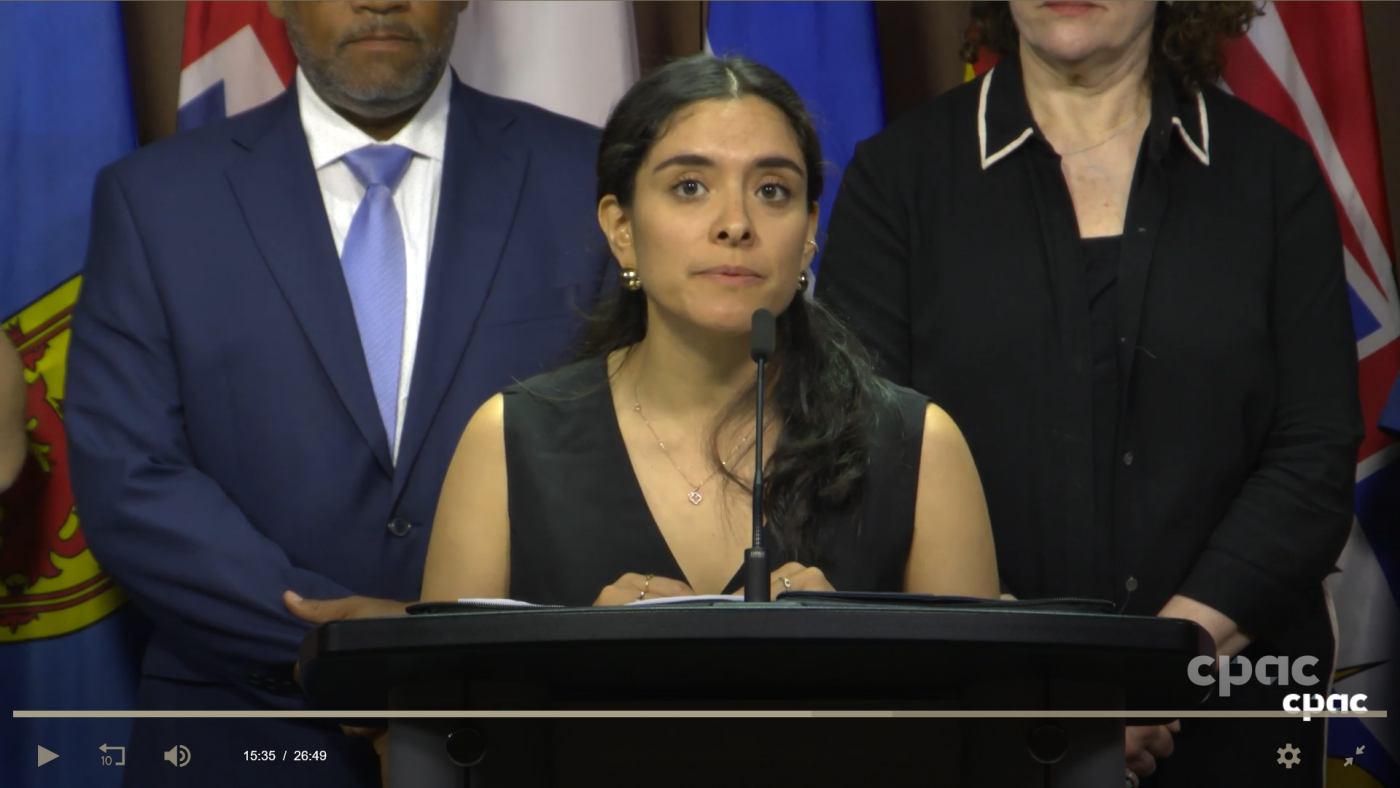

This statement was delivered on 14 July 2026 by our policy specialist Ana Laura Zarco, alongside our partners lawyer Emma Phillips, Canadian Health Coalition, Canadian Medical Association, Alberta's Friends of Medicare, and Canadian Doctors for Medicare.
Good morning. My name is Ana Laura Zarco with Action Canada for Sexual Health and Rights.
As we have heard already, we are here to talk about what is at risk with Alberta's Bill 11.
This is not a simple debate about health care delivery or only about Alberta.
It forces us to ask some fundamental questions. Who do we want to be? Are we a Canada that proudly guarantees healthcare to every single person, regardless of your job, your income, or your postal code? Or do we surrender to a system in which your health is determined by your wealth, and life-saving care belongs only to those who can afford the price?
For people seeking sexual and reproductive health care, the answer is clear. Sexual and reproductive health and rights depend on a strong public health care system.
When we weaken public health care, we weaken access to abortion care, we weaken gynecological surgeries, and we weaken treatment for people living with endometriosis and other chronic reproductive health conditions. This also has serious consequences for sexual health services that depend on timely access. For example, testing and treatment for STIs, as well as cervical cancer screening, are most effective when people can access care quickly. When timely access depends on the ability to pay, we put both individual and public health at greater risk. We create new barriers to timely, essential care.
These barriers fall hardest on those already facing challenges: young people, workers in precarious employment, newcomers, survivors of domestic violence, and families struggling to afford groceries. These are the people who cannot simply pay their way to the front of the line.
Bill 11 creates a two-tier system in which timely care increasingly depends on the money in your pocket rather than your medical needs.
That is not universality. That is not accessibility. And it is not the promise of the Canada Health Act. And The federal Minister of Health has a duty to act.
We all recognize that Canada's health system is under strain, and we all want shorter wait times. We are told privatization will achieve that. But the evidence is clear: countries that have introduced parallel private payment systems have not reduced wait times for everyone. Instead, privatization draws health professionals and resources away from the public system, increasing wait times and deepening inequity.
Universal health care is one of Canada's greatest strengths. It reflects our belief that dignity, health, and opportunity belong to everyone, not only those who can afford to pay.
To the federal Minister of Health, our message today is simple: the Canada Health Act exists to protect universal, accessible, and publicly funded health care. Bill 11 undermines those principles. The federal government has both the authority and the responsibility to enforce the Canada Health Act and protect the rights of Canadians.
This is a defining moment.
At a time when sexual and reproductive health services are already underfunded, and reproductive rights face growing attacks worldwide, Bill 11 represents another assault on reproductive rights, moving us backwards.
The answer we are looking for is not privatization. The answer is to invest in public health care. To invest in sexual and reproductive health. To invest in the social programs that allow people to live with dignity.
Because health is not a commodity. Health is not a privilege. Health is a human right. And reproductive health is an essential part of that right.
The Canada worth fighting for is one where no one is denied care because of the money in their pocket.
That is the future we should be building.
Thank you.